
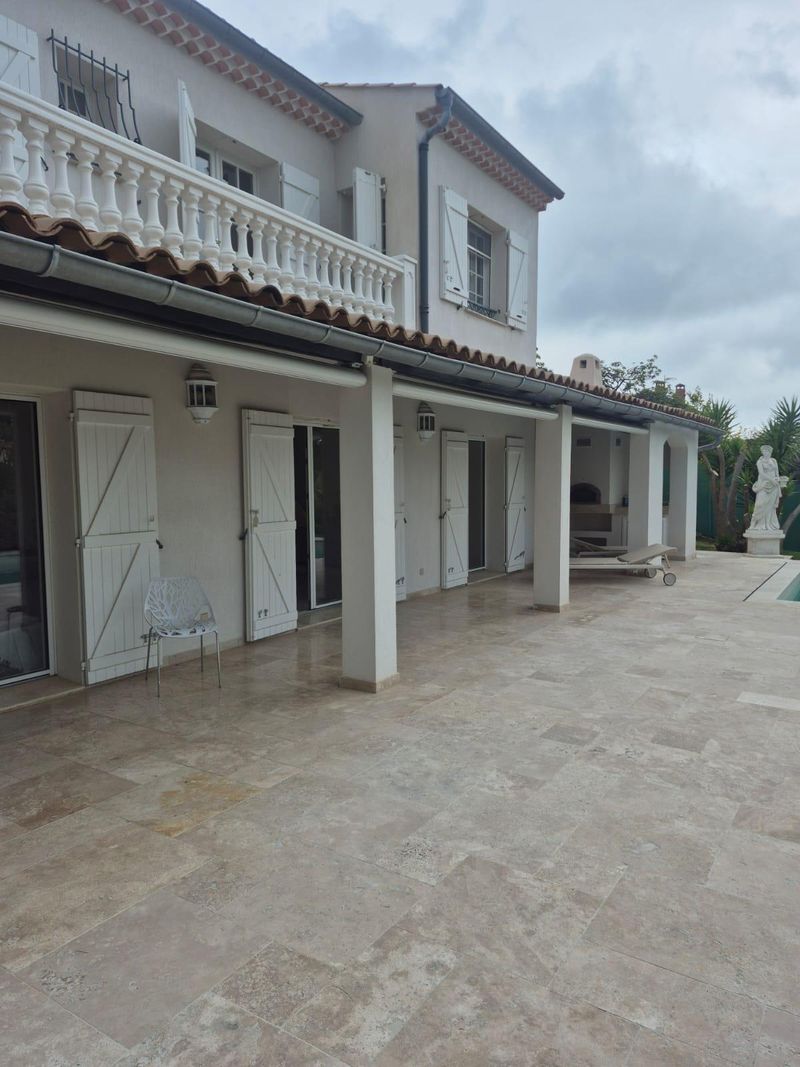
Large Villa Renovation on the French Riviera: A to Z Guide
Renovating a large villa on the French Riviera is a category of project all its own. Unlike a flat renovation or even the refurbishment of a single room, the total transformation of a 300, 400, 500 m² villa (or more) mobilises every building trade simultaneously. Masonry, plumbing, electrical, climate control, joinery, tiling, painting, landscaping, pool work — all converge on the same site, often for six to twelve consecutive months.
On the Riviera, these projects take on an additional dimension: the mild but salt-laden climate, the specifics of the local building stock (1970s-80s Provençal villas, contemporary properties, prestige estates on the heights of Nice, Cap d'Antibes, Mougins or Saint-Jean-Cap-Ferrat), the aesthetic demands of an international clientele, and local administrative constraints make each renovation a unique undertaking.
This guide consolidates, in seven stages, the essential lessons we've drawn from over ten years of villa projects on the Côte d'Azur. It is written for owners considering a total or near-total renovation — and who want to understand what they are committing to before signing the first quote.
Stage 1: Diagnostics and Design
The classic mistake on a large villa is to start the works before understanding the building. A total renovation deserves several weeks — sometimes several months — devoted solely to diagnostics and design. That time decides whether the site will run smoothly or descend into chaos.
Complete technical survey
Begin with an honest assessment of the existing fabric: load-bearing structure (walls, floors, framing), condition of the façades and roof, quality of the networks (water, electricity, gas, drainage), presence of asbestos or lead in buildings predating 1997, moisture levels, existing insulation. On the French Riviera, 1970s-80s villas frequently share recurring weaknesses: undersized electrical panels, ageing copper plumbing, single-glazed windows, and heating systems based on oil or collective gas that no longer meet current energy standards.
Defining the brief
How many bedrooms, how many bathrooms, open or compartmented reception areas, study, cinema room, wine cellar, sports area, master suite, guest rooms, staff quarters? This programming phase is decisive. An owner who changes the location of a bedroom after the shell is complete blows the budget — the brief must be locked early and clearly.
Architect or project manager?
For a villa exceeding 170 m² of floor area, the involvement of an architect registered with the Order is legally required if you file a planning permit that affects external appearance or surface area. Even below that threshold, engaging an experienced architect or project manager for the design brings considerable returns: optimised volumes, natural light, circulation, and validation of technical choices.
Administrative process
Depending on the scope, you will need either a simple déclaration préalable, a full planning permit (permis de construire), or no authorisation at all. Any change of floor area, external appearance, façade openings, or use triggers a filing with the local urbanism office. On Nice and the Riviera, allow two to four months of processing for a planning permit. For properties in protected zones or within the perimeter of a listed monument, the Architecte des Bâtiments de France (ABF) must validate aesthetic choices — a delay to factor into the schedule.
Stage 2: Structure and Shell
Once the brief is locked, work begins with the structural phase. Invisible once finished, this stage is the most decisive for everything that follows.
Selective demolition
On a 1970s-80s villa, total renovation typically starts with extensive demolition: removal of old floors and tiles, taking down non-load-bearing partitions, stripping walls back to substrate, removing joinery, dismantling obsolete sanitary fittings and equipment. If the survey has revealed asbestos (still common in tile adhesives, vinyl flooring, certain roofing materials) or lead, asbestos and lead removal must be entrusted to a certified contractor (SS3 or SS4) before any other work.
Structural modifications
Opening a load-bearing wall to create an open-plan living-and-kitchen area, relocating a staircase, creating a mezzanine, adding a master suite as an extension, building out a habitable basement — all these interventions require a structural engineer's report, who will size the reinforcements (steel IPN beams, columns, concrete lintels). On seaside villas, account for corrosion of structural steel exposed to salt air; anti-corrosion treatment is essential.
Roof and façades
A total renovation is the ideal moment to address these two expensive items. Roof refurbishment (replacement of canal or Roman tiles, external insulation under the roof, skylights), façade restoration (chipping back degraded render, applying traditional lime render, mineral paint pigmented through the mass). On the hills of Nice or Mougins, Provençal villas benefit from preserving their aesthetic codes (light ochres, beiges, terracotta) rather than slipping into the pure white that jars with the Mediterranean landscape.
External joinery
The windows and French doors of older villas almost always need replacing. Choose high-performance double glazing (Uw < 1.4 W/m².K) with thermal-break aluminium or wood-aluminium frames for the principal rooms. On the Riviera, southern exposure calls for a low solar factor (g < 0.4) to prevent summer overheating.
Stage 3: Plumbing, Electrics, Climate Control
On a large villa, the technical networks represent a substantial share of the project — often 20 to 30% of the total budget. They are also the area where false economies cost the most over time.
Complete plumbing
On a 400 m² villa with three or four bathrooms, a kitchen, a utility room and a pool, the supply and drainage network amounts to hundreds of metres of pipework. Full replacement is almost always the right call: switching to multilayer pipe for supply (more durable and resistant to Riviera limescale), PVC or sound-insulated polypropylene for drainage, installing a water softener (essential on the Côte d'Azur), and a properly sized hot water system (thermodynamic cylinder of 300-500 L or solar thermal panels).
Electrical to standards
The French standard NF C 15-100 governs any new or renovated installation. On a large villa, plan for a main distribution board and several sub-boards (one per floor), dedicated circuits for each utility room (kitchen, bathrooms, utility), a robust earth bond, and generous pre-cabling for RJ45 network outlets and home automation points. This is also the right moment to switch to KNX or an equivalent system for lighting, blinds, heating and security — an investment that materially increases the value of the villa.
Reversible air conditioning
On the Riviera, air conditioning is no longer a luxury: summers regularly push past 35 °C. Choose a VRV system (variable refrigerant volume) or premium multi-split (Daikin, Mitsubishi, Toshiba) with ducted indoor units concealed in false ceilings. For villas targeting BBC or RE2020 certification, combining reversible air conditioning with an air-water or geothermal heat pump delivers the best energy performance.
Ventilation
A double-flow VMC is the reference on a heavy renovation: it manages air renewal while recovering heat from the extracted air. On a 400 m² villa, this can mean a 15-20% saving on heating costs.
Stage 4: Bathrooms
A large villa typically has three to six bathrooms: master suite, guest rooms, children's bathrooms, separate WCs, pool house bathroom. It is one of the most visible items in the project and the one that most signals the property's value.
The master bathroom — the centrepiece
The master suite bathroom has become a genuine living space in its own right: 15 to 25 m², double vanity, freestanding standalone bathtub, separate walk-in shower, wall-hung WC in its own compartment, sometimes a sauna or hammam adjacent. High-end materials dominate: large-format tiling with natural stone or mineral concrete effect, bespoke cabinetry in veneered wood or matt lacquer, indirect warm LED lighting.
Secondary bathrooms
For guest rooms and children, the same principles apply on a more contained scale: walk-in shower as standard, wall-hung vanity unit, backlit mirror, thermostatic matt black or brushed brass brassware. Porcelain stoneware in concrete or stone effect harmonises with the rest of the house.
Waterproofing and plumbing
On every bathroom, the SPEC system (waterproofing under tiling) to DTU 65.10 is mandatory. Drainage stacks must be sized according to the number of fixtures, and each bathroom must have an accessible isolation valve. For a complete deep-dive, read our bathroom renovation guide.
Stage 5: Interior Finishes and Travertine
The visual signature of a successful villa comes down to a handful of technical decisions about surfaces and finishes. On the Riviera, certain materials have established themselves as references.
Travertine
A natural limestone in cream, beige or ivory tones, travertine has become the emblematic material of high-end villas on the Côte d'Azur. Laid in large slabs inside (reception rooms, entrance halls, bathrooms) and outside (terraces, pool surrounds, paths), it offers remarkable visual continuity between spaces. Its matt appearance, its lightly filled porosity, and its warm touch make it a premium choice — but it requires an initial hydrophobic and oleophobic treatment and cleaning with suitable products (never acidic).
Other flooring
For bedrooms and some living areas, solid oak parquet (18 to 25 cm wide planks, oiled finish) remains a classic. Polished concrete is a very interesting modern option for open-plan spaces — it offers a monolithic finish with no joints. For wet areas outside bathrooms (kitchen, utility), large-format porcelain stoneware in stone effect is a safe bet.
Paint and decorative finishes
Mineral paints (lime, silicate) are reserved for façades, but indoors, premium matt paint (Farrow & Ball, Ressource, Tollens Haute Couleur) in neutral tones — off-white, linen, taupe, sage green — structures the space. Decorative renders (mineral concrete, tadelakt in bathrooms) add texture in feature areas.
Interior joinery
Bespoke interior doors (minimum 2.40 m height), built-in floor-to-ceiling wardrobes, walk-in dressing room in the master suite, custom bookcases: these workshop-made elements transform a good villa into an exceptional one.
Stage 6: Exteriors, Terraces and Pool
On the French Riviera, outdoor spaces count as much as the interior. Renovating a villa cannot ignore this dimension — and this is often where owners entertain their guests nine months out of twelve.
Terraces
A large villa usually has several terraces: main covered terrace, pool terrace, bedroom terrace, balconies. Travertine paving (60 × 90 cm or 80 × 80 cm format) laid with reduced joints delivers a high-end finish. For terraces on existing slabs, installation on adjustable pedestals allows slopes to be absorbed and creates a technical void for services.
Pool
If the villa already has a pool, the renovation is the ideal opportunity to redo the waterproofing (reinforced PVC membrane or polished render), upgrade the filtration system (saltwater or electrolysis), install an automatic submersible cover, and rework the surround. For a new pool, budget between €50,000 and €200,000 depending on dimensions, shape (lap pool, mirror pool, infinity edge), and options (heating, counter-current, RGB LED lighting).
Landscaping
Century-old olive trees, cypresses, lavenders, agapanthus, palms: the Mediterranean plant palette defines a villa's identity on the Riviera. An experienced landscape designer — one who knows the chalky soils of the Var and Alpes-Maritimes, prevailing winds, and orientations — is as valuable as an interior architect. Plan for a programmable automatic irrigation system and, ideally, a rainwater recovery system.
Exterior lighting
Well-designed landscape lighting transforms the villa at night: marker lights along paths, uplighting on olive trees and the façade, submerged pool lighting, recessed step lights. Choose warm sources (2700 K) and orientable IP65-minimum fittings.
Stage 7: Budget, Timeline and Coordination
A total renovation of a villa on the French Riviera is a structural project that demands clarity on financial envelope and schedule.
Budget brackets
For a total renovation of a 300 to 500 m² villa on the Côte d'Azur, expect:
- Premium standard renovation (good quality materials, mid-range equipment, well-executed finishes): €2,000 to €3,000 per m², or €800,000 to €1,500,000 for 400 m².
- High-end renovation (noble materials, branded equipment, demanding finishes, home automation, integrated air conditioning): €3,000 to €5,000 per m², or €1,200,000 to €2,500,000 for 400 m².
- Prestige renovation (renowned architect, exceptional materials, high-end audiovisual systems, infinity pool, pool house): €5,000 to €10,000 per m² and beyond.
These brackets typically exclude extensive exteriors (full landscaping, new pool), furniture, artwork, and architect's fees (10 to 14% of construction cost).
Realistic timeline
A total villa renovation generally takes 6 to 12 months of effective works, plus 3 to 6 months of upstream phase (diagnostics, design, permits, file submissions, contractor consultations). On a 400 m² villa with extensive exteriors, plan for twelve to eighteen months between the decision to renovate and final handover. Classic delays come from: (1) permit processing times or ABF opinions in protected zones; (2) lead times for bespoke joinery (12-16 weeks); (3) discoveries during demolition (asbestos, lead, degraded structure).
Coordinating the trades
This is the critical point. On a villa site, ten to fifteen different trades succeed or coexist. The project manager (often the general contractor or a construction economist) must orchestrate this dance while respecting technical precedences: electrical before plasterboard, plasterboard before tiling, tiling before cabinetry, and so on. Poor coordination can add three months to the schedule and 10% to the budget.
Choosing the contractor
For a total renovation, two models coexist: (1) the multi-trade approach with a project manager coordinating several independent contractors, and (2) the general contractor who integrates all trades under a single contract. The second approach is generally preferable for an owner not present on site: a single point of contact, one contract, overall responsibility in case of issues. To choose the right partner, read our guide to choosing a renovation company.
Ready to Renovate Your Villa?
Renovating a large villa on the French Riviera is a major undertaking that deserves serious preparation, an experienced partner, and a clear vision. Done well, such a renovation radically transforms the property: significantly revalued real estate, multiplied daily comfort, and very often a private pride — that of having created a living space that genuinely reflects who you are.
At RUDEK Côte d'Azur, we have been guiding clients through total renovation projects since 2012, from initial diagnostics to handover. Our team brings together every trade required — masonry, plumbing, electrics, climate control, joinery, tiling, painting, landscaping — under a single contract. Discover our latest project: the total renovation of a 400 m² villa in Nice, with its three before/after sliders on the bathrooms and full gallery.